The Botany of Desire: Michael Pollan

Michael Pollan, The Botany of Desire:

What... was the knowledge that God wanted to keep from Adam and Eve in the Garden? Theologians will debate this question without end, but it seems to me the most important answer is hidden in plain sight. The content of the knowledge Adam and Eve could gain by tasting of the fruit does not matter nearly as much as its form... from nature. The new faith sought to break the human bond with magic nature, to disenchant the world of plants and animals by directing our attention to a single God in the sky. Yet Jehovah couldn't very well pretend the tree of knowledge didn't exist, not when generations of plant-worshipping pagans knew better. So the pagan tree is allowed to grow even in Eden, though ringed around now with a strong taboo. Yes, there is spiritual knowledge in nature, the new God is acknowledging, and its temptations are fierce, but I am fiercer still. Yield to it, and you will be punished.

So unfolds the drug war's first battle.
"
Showing posts with label California. Show all posts

Friday, October 1, 2010

California Gov. Arnold Schwarzenegger Decriminalizes Cannabis

San Francisco Gate

Citing the need to reduce spending on prosecution and courts, Gov. Arnold Schwarzenegger signed a measure that makes marijuana possession an infraction, on par with traffic and littering tickets.

The Republican governor's unexpected support for the measure comes one month before voters decide whether to legalize adult recreational use of marijuana in California.

"In this time of drastic budget cuts, prosecutors, defense attorneys, law enforcement and the courts cannot afford to expend limited resources prosecuting a crime that carries the same punishment as a traffic ticket," wrote Schwarzenegger, who opposes Proposition 19, the marijuana initiative.

The law, which takes effect immediately, reduces possession of up to an ounce of marijuana - about the amount that will fit in a sandwich-size bag - from a misdemeanor to an infraction. Already, marijuana possession was the only misdemeanor under California law that didn't allow for jail time.


edit to clarify/add

all laws passed in CA take effect on Jan. 1 of the next year so this law will not be in effect until that time.

here is a link to the bill

Denver Examiner

The new law will not take effect until January 1, 2011, and it will still remain relevant even if Proposition 19 passes.

Prop 19 leaves misdemeanor possession penalties in place for public use and smoking in the presence of children; under SB 1449, these offenses are now simple infractions. Leaving dispensary owners opposed to Prop 19 with one less objection.

California NORML originally called for making petty possession an infraction when the state passed its original landmark decriminalization law in 1975, but the Legislature made it a minor misdemeanor punishable by a maximum $100 fine.

This marks the first time in 35 years that penalties for non-medical use of marijuana have been reduced in California.

Tuesday, September 28, 2010

Drug Criminalization Structure Squanders $88 Billion PER YEAR

Weed Wars blog at the Sacramento Post

A new report, "The Budgetary Impact of Ending Drug Prohibition," has been published by Harvard economist Jeffrey A. Miron and Katherine Waldock, a PhD candidate at the Stern School of Business at New York University. This report has been published by The Cato Institute.
An announcement for Cato study asserts that the "drug criminalization structure" nationally "squanders a total of $88 billion a year - $41.3 billion spent to prosecute the 'war on drugs' and $46.7 billion in lost potential revenue from the taxation of legal drug sales."

A .pdf of the report is available at the link above.

Friday, September 24, 2010

Legal Cannabis is the Best Thing for Medical Marijuana Patients Since Prop. 215

In recent weeks some people in California have spoken out against Prop. 19 by declaring it hurts medical marijuana patients.

A medical marijuana and Prop. 19 supporter asked California attorney David Nick to comment.

For 18 years, David Nick has successfully litigated a cornucopia of issues regarding cannabis and the applicable laws in both trial and appellate courts. He has not confined his practice to marijuana law, but also litigates cases involving constitutional rights and criminal procedure.

David Nick has never lost a jury trial in a state marijuana case including many precedent setting trials involving some of the most revered figures in the medical marijuana movement such as Brownie Mary, Dennis Peron (Nick has been Peron’s sole attorney since 1994) and Steve Kubby.


Here's what Nick has to say:

PROP. 19 IS THE BEST THING TO HAPPEN TO MMJ PATIENTS SINCE PROP. 215

Anyone who claims that Proposition 19 will restrict or eliminate rights under the Compassionate Use Act (CUA) or the Medical Marijuana Program (MMP) is simply wrong. If anything, Proposition 19 will permit individuals to grow and possess much more than ever before with patients, coops and collectives still receiving the same protections they are entitled to under the CUA and MMP.

Here is why.

The legal arguments claiming the "sky will fall" if Prop. 19 passes are based on the fallacious conclusion that the Initiative invalidates the CUA and MMP. This baseless fear stems from a flawed legal analysis which focuses on just about every portion of Prop. 19 EXCEPT the relevant portions. This flawed legal analysis is driven by an incorrect understanding of the rules of statutory construction.

PROP. 19 PROVIDES ADDITIONAL PROTECTIONS TO PATIENTS FROM THE ACTIONS OF LOCAL GOVERNMENT AND LOCAL LAW ENFORCEMENT

Section 2B presents the controlling and relevant purposes for understanding what Prop. 19 can and cannot do. This section EXPRESSLY excludes the reach of Prop. 19 from the CUA and MMP. Sections 2B (7 & 8) specifically state that the purpose of this initiative is to give municipalities total and complete control over the commercial sales of marijuana "EXCEPT as permitted under Health and Safety Sections 11362.5 and 11362.7 through 11362.9.”


This is an email from the attorney. You can read the rest of it here

David Borden, Exec. Director of Stop the Drug War, brings this email to the attention of the larger public and notes that opposition is not across the board among those currently involved in the medical marijuana community.

Fortunately, only some medical marijuana people are so shortsighted as to oppose this historic and important measure. Harborside Health Center in Oakland, and the Berkeley Patients Group are among the top quality groups lending their support to Prop 19. But it's still worth asking, why are some other medical marijuana providers opposing it?

Famed Canadian Marc Emery, from his US prison cell offered the obvious explanation: money.


Of course, the answer could also be a misreading of the current Proposition or simply failing to read the language and arguments themselves among those who have joined those who put their financial gain above every person in this nation who stands to benefit from an end to the war on cannabis.

Tuesday, September 14, 2010

Former San Jose Chief of Police Calls For Legalization of Cannabis

Alternet

Joseph D. McNamara writes:
California voters have a chance on this November's ballot to bring common sense to law enforcement by legalizing marijuana for adults. As San Jose's retired chief of police and a cop with 35 years experience on the front lines in the war on marijuana, I'm voting yes.

He cites the arguments of opponents of Prop. 19 and shoots them down.Regarding the claim that Mexican cartel violence would increase, McNamara says:
No one today shoots up the local neighborhood to compete in the beer market. The federal Drug Enforcement Administration estimates that Mexican cartels derive more than 60 percent of their profits from marijuana. How much did the cartels make last year dealing in Budweiser, Corona or Dos Equis? Legalization would seriously cripple their operations. With more than 20,000 people in Mexico killed in the past three years in drug turf battles, which are spreading north of the border, undercutting the cartels is an urgent priority for both Mexicans' and Americans' safety.

Regarding the lack of political courage and the vested interests of certain groups:

The same professional politicians who recklessly caused huge budget deficits predictably are taking an irresponsible position of opposing the "evil" of cannabis legalization, just as they opposed California voters' decision a decade ago to legalize medical marijuana. The California Police Chiefs Association, of which I have been a member for 34 years, is also in opposition. Personally, I have never even smoked a cigarette, let alone taken a hit from a bong, and while I have great respect for the police chiefs, I wouldn't want to live in a country where it is a crime to behave contrary to the way cops think we should.

That perhaps brings up the most significant and least considered cost of criminalizing marijuana - turning people into criminals for behavior of which we disapprove, even though it doesn't take others' property or endanger their safety. It is worth remembering that our last three presidents, Bill Clinton, George W. Bush and Barack Obama, would have been stigmatized for life and never would have become presidents if they had been in the wrong place at the wrong time and been busted for pot during their reckless youthful days. Countless other Americans weren't so lucky. California voters have an opportunity in November to return reason to our state by decriminalizing adult use of marijuana.

Politicians become irrelevant when they do not have the courage to look at facts and recognize the value of changes in laws that - in this case, most certainly - were bad laws to begin with - born of corruption and collusion with favored corporate entities. Sort of like how we can't get to the point of health care reform in the U.S. - because political institutions have been so corrupted by the corporate cartels called health insurance and the pharmaceutical industry.


McNamara is joined by other members of LEAP (Law Enforcement Against Prohibition)
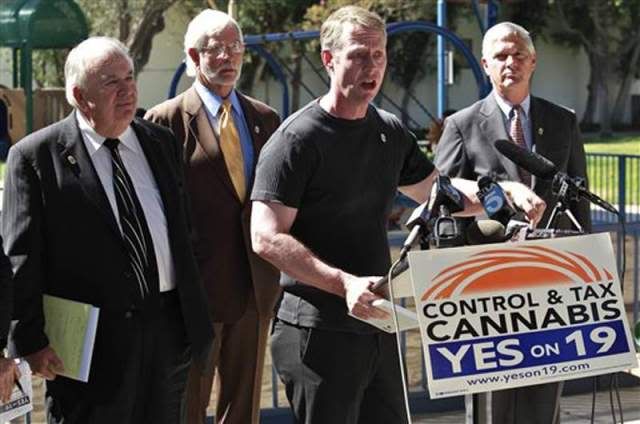
From left, Stephen Downing, retired deputy chief of the Los Angeles Police Department, William Fox, former deputy Los Angeles County District Attorney's Office, former Torrance Police Department beat officer and drug identification expert Kyle Kazan, at podium; and retired Orange County Superior Court Judge Jim Gray, right. (AP Photo/Damian Dovarganes)

Their statement was noted in the Press Democrat
Current law enforcement officials are obligated to support laws and are ethically unable to oppose it in public, but retired officers can speak out, said McNamara, who is now a research fellow at Stanford University’s Hoover Institute.

“We’re pushing police into a war they didn’t declare and they can’t win, and that comes at so much cost to taxpayers and society,” he said.

Nationally, President Barack Obama’s director of the Office of National Drug Control Policy, Gil Kerlikowske, spoke out against the proposed law. Nine former Drug Enforcement Administration bosses wrote in a letter to Attorney General Eric Holder that legalizing the drug threatens federal authority.

Federally authority should be threatened when it insists on bad laws.

Prosecutor who indicted Marc Emery ("king of pot") : Legalize It

Seattle Times

As Emery's prosecutor and a former federal law-enforcement official...I'm not afraid to say out loud what most of my former colleagues know is true: Our marijuana policy is dangerous and wrong and should be changed through the legislative process to better protect the public safety.

Congress has failed to recognize what many already know about our policy of criminal prohibition of marijuana — it has utterly failed. Listed by the U.S. government as a "Schedule One" drug alongside heroin, the demand for marijuana in this country for decades has outpaced the ability of law enforcement to eliminate it.

Not only does our policy directly threaten our public safety and rest upon false medical assumptions, but our national laws are now in direct and irreconcilable conflict with state laws, including Washington state. So called "medical" marijuana reaches precious few patients and backdoor potheads mock legitimate medical use by glaucoma and chemotherapy patients. State laws are trumped by federal laws that recognize no such thing as "medicinal" or "personal" use and are no defense to arrests by federal agents and prosecution in federal courts.

So the policy is wrong, the law has failed, the public is endangered, no one in law enforcement is talking about it and precious few policymakers will honestly face the soft-on-crime sound bite in their next elections.

While I don't share McKay's stereotypes about many cannabis users, his rational approach to the issue of cannabis laws in this nation is necessary and long-overdue from the many, as he notes in his op-ed, who are in law enforcement who recognize the law is the worst offender in regard to cannabis drug policy in this U.S.

McKay's op-ed only touches briefly, however, on the real problem with making rational changes to current law: the toxic political environment promoted by right-wing politicians who care more about scoring points on a political opponent than they do about the welfare of American citizens.

John McKay knows this aspect of American political life personally. He was one of the attorneys who was ousted by the theocratic quislings in the Gonzales Attn. General's office, most likely because of his attempt to keep an investigation into the murder (in his home) of Asst. U.S. Attn. General Tom Wales (who took on the NRA, the death penalty and white-collar crime.)

Jeffrey Toobin wrote about the incidents leading to the firing in The New Yorker:
On September 22, 2006, McKay’s office received a glowing evaluation from the Department of Justice. On December 7th, McKay, along with six other U.S. Attorneys, was fired.

...Gonzales’s justifications for McKay’s dismissal now seem unlikely to be true, because it has become clear that Justice Department officials were seeking to fire McKay before 2006. On March 2, 2005, Kyle Sampson, Gonzales’s chief of staff, included McKay’s name on a list of thirteen U.S. Attorneys to be fired, in an e-mail to Harriet Miers, the White House counsel. Sampson sent the e-mail four months after the 2004 elections, and after McKay decided not to bring charges against the Democratic Party, or people affiliated with it, in Washington State, in the wake of a narrow victory by Christine Gregoire, the Democratic candidate, in the governor’s race. The contest, which was resolved after two recounts, prompted a lawsuit by the state Republican Party alleging widespread voting irregularities.

Several of the fired U.S. Attorneys had declined to prosecute Democrats in electoral disputes. Many Democrats have suggested that the prosecutors were dismissed by Gonzales and the Bush White House in retaliation for failing to advance Republican political objectives.

An interview with Ethan Nadelmann, exec. director of the Drug Policy Alliance

Alternet

Nadelmann talks about the concept of harm reduction as a paradigm shift.
(From drug policy)...in which criminal justice approaches are dominant to one in which health approaches are dominant. So much of drug policy takes place on the ground, and so much involves both governmental and non-governmental agencies and workers -- cops, prosecutors, housing, public welfare, health, you name it. We’re just trying to come up with pragmatic solutions.

These events push in a new direction: To reduce our reliance on a criminal justice and punitive approach in dealing with drugs, and to elevate the role of health in dealing with people who are addicted; To focus criminal justice resources on the harms that people do to one another, rather than simply arresting people for drugs; To move toward decriminalization of drug possession, both for those who are addicted and want help and for those who don’t have a drug problem and should essentially be left alone.

Nadelmann goes on to mention that Prop. 19, the ballot initiative to legalize cannabis, has an amazing 70% recognition rate - that's a phenomenal number of people who know what this issue is and why it is on the ballot. He compares this moment with past initiatives that involved reforms in the criminal justice system (Prop. 5) - which was torpedoed by a political maneuver by Jerry Brown (with help, Nadelmann notes, from the quarter million that Meg Whitman devoted to its demise), and Prop. 25, a move to treatment rather than punishment in drug sentencing that passed with 61% of the vote a decade ago, in spite of opposition from politicians and law enforcement. At this moment, depending on polls, Prop. 19 polls at 50/50 (tho electronic polls show a majority of Californians favor the initiative.) Nevertheless, in spite of recognition, Prop. 19 is not a sure thing and voter turn out will be essential to its passage.

He notes that:
There’s no simple easy way to jump from where we are today to a world in which marijuana is legally regulated and taxed in the US and Mexico and much of the rest of the world. It’s going to be a messy political process, with inconsistencies in laws and enforcement and different forms of decriminalization and people exploiting that, but it’s ultimately the only solution that can really reduce the violence and murder and mayhem. We really have no choice but to head down this road, negotiating the twists and bumps along the way, until both the US and Mexico, and other countries as well, are ready to embrace a more rational and orderly system of marijuana regulation.

Nadelmann credits the Obama administration for its stance and actions on three policy changes: raids on medical marijuana facilities, needle exchange and differential sentencing for types of cocaine (crack v. powder.) He also talks about the political reality of any attempt to create change with the current Republican mindset and the nasty political atmosphere that seeks to label any move away from Calvinist punishment drug policy to health-centered harm reduction as a "soft on crime" stance. Current federal funding reflects this political reality.

Nevertheless, Nadelmann observes: Obama made another commitment when he was running for office – that he would no longer allow science to be trumped by politics. But in the drug area, they continue to let it happen.

From Terrence McNally (the interviewer):
On July 27 the House unanimously passed HR5143, which, if enacted, creates a bipartisan commission to conduct a top to bottom review of the entire criminal justice system, and offer concrete recommendations for reform within 18 months. This is the companion bill to Senator Jim Webb’s S714, already approved by the Senate Judiciary committee. According to Senator Webb, legalization should be on the table for discussion.

These are bills to watch for anyone who supports sane drug policy. One issue the House can bring up for consideration is the rescheduling of cannabis. This one change can have major implications. It's not the only change we need, but it's a major move that needs to be made to bring current drug law in line with current medical research.

Monday, August 9, 2010

Vancouver, B.C. Concerns on the Impact of Prop. 19 on the Canadian Economy

Cannabis News via The Victoria Times-Colonist

In a column on the Guardian’s website this week, B.C. writer Douglas Haddow writes that a move to legalization would be “devastating to the Canadian economy, halting the flow of billions of dollars from the U.S. into Canada.”

B.C. marijuana activist Marc Emery – the selfstyled “Prince of Pot” who is awaiting sentencing in the U.S. for distributing cannabis seeds – - recently told a Vancouver website that “the homegrown market will evaporate.”

Marijuana production generates at least $3 billion to $4 billion in B.C. alone – due, in large part, to heavy demand from potheads south of the border, said Darryl Plecas a criminology professor at the University of the Fraser Valley in Abbotsford.

Plecas said he estimates that about 70 per cent of all marijuana produced in B.C. is sent to the U.S. and much of it goes to California.


(I love the criminology professor's "judicious" use of language.)

Other observers, however, are more circumspect about how crippling legalization would be for Canadian producers, pointing out that “B.C. Bud” still enjoys a reputation in many circles as “the Rolls-Royce” of marijuana and that there are many other U.S. states – besides California – that covet Canadian-grown marijuana.


The article goes on to note various opinions about the the immediate impact (Mexican bud will fare worse, the illegal exchange of Canadian pot and cocaine will continue, the rise of the loon against the dollar hasn't hurt exports...)

Thursday, August 5, 2010

Monday, August 2, 2010

Democrats Want the Pro-Prop 19 Vote, but not the Legislation

Huffington Post (Russ Bellville)

Ryan Grim at Huffington Post reports on the notion going round political circles that California's Prop 19 (and, to a lesser extent, medical marijuana initiatives in Arizona and South Dakota, and dispensaries for medical marijuana in Oregon) will be for the Democrats what anti-Gay Marriage Equality amendments were for Republicans - the turn-out-the-base social wedge issue that helps their candidates on the ballot.

...Democrats are in for a surprise. See, Karl Rove and the Republicans really believed in the initiatives they were pushing. They had a frame for it - "one man one woman" - that resonated with their voters and the overall worldview espoused by most of their downticket candidates. So when that Religious Right base came out in 2004, energized to vote against dreaded homosexuals and for the continuation of all that was good, true, and Christian in America, they had George W. Bush and a whole slew of Republicans to vote for that echoed that sentiment.

What do Democrats have to offer the cannabis consumer who comes out for a 2010 election? Unlike Rove and the Republicans, the Democrats don't really believe in these initiatives (publicly). Sen. Boxer, Sen. Feinstein (a former mayor of San Francisco, c'mon now!), and former Gov. / current AG Jerry "Moonbeam" Brown all publicly oppose Prop 19...

...[In 2008, social liberals] "surged", in the real world and especially online, and got Obama elected. We even got him a massive majority in Congress. We were thrilled when he asked us online what items we'd like to see on the new administration's agenda and multiple times we responded with "legalize marijuana", topping almost every public survey and dominating with 16 of the top 50 questions in the largest survey. So what did we get in response? Something we in marijuana law reform simply call "The Chuckle"

...Republicans already have the frames of "small government", "personal responsibility", and "states rights" to work within. If marijuana legalization in California passes by a wide margin and sees support from the women, minorities, and young people the GOP desperately needs to rebuild their party, how long before they begin framing the War on Drugs as the "big government", "nanny state", and "federal overreach" that it is? ...They can easily point to the Democratic Congresses of the 1980s that created the mandatory minimums and the last three Democratic presidents who supported decriminalization and inhaled or didn't inhale yet arrests kept increasing (at the greatest rate under Clinton, they'll note).

...Just in time for 2012 when a vocally pro-marijuana legalization, anti-prohibition former governor of New Mexico named Gary Johnson will be fighting for the Republican nomination.

The Obama Administration has been incredibly tone deaf and outright offensive about the issues that brought out the base in 2010, from gay rights to cannabis-law modification to women's reproductive choice to overturning the abuses of power of the Bush administration in regard to FISA, for instance, while seemingly engaged in an effort to court the social/religious conservative Republican and Democratic Dixiecrat base that comprises a smaller number of voters than the liberal and libertarian free market one (based upon Pew polling from 2008 that divided voters into voting and economic sectors.)

This tact would appear to relate to the Democratic idea that social liberals have no other party to vote for and to Rahm Emmanuel's view of the liberal base as "fucking retards."

The Dixiecrats and their kissing cousins in states like Nebraska (Ben Nelson) threaten to alienate the Democratic base from the party - while offering little in return for this pandering if you look at Nelson's votes, for instance.

Democrats seem to be fighting the political wars of the 1980s and the 1990s while defining themselves in terms derived from the Republican attack machine, rather than creating a truly hopeful vision for an America in a new millennium.

Oakland's Post Drug War Marshall Plan

L.A. Times

This article is a profile of Jeff Wilcox, the person who has promised a a $20 million dollar investment in Oakland to create a large-scale growing operation.

Wilcox quote: In essence, you could say big business is here.

Comparing the economic potential of tetrahydrocannabinol to silicon chips may seem far-fetched. Some observers dismiss the notion as the fever dream of budget-traumatized politicians. But others think Oakland could be uniquely positioned to capitalize on the business opportunities created by the growing tolerance toward marijuana.

[City Council Member Rebecca] Kaplan said she believed that Oakland has two essential ingredients other California cities do not: political will and industrial space. "Oakland has been a major hub of the medical cannabis movement, so that's part of what I mean when I say political will," she said.

No other city has provided such red-carpet treatment. Oakland is essentially trying to set up legal sanctuaries for pot businesses, although the move may prove too brazen for federal narcotics agents who recently called city officials to request a copy of the [legal, large-scale cannabis growers] ordinance.

Oakland, like Silicon Valley, has been fertile ground for entrepreneurs and innovative thinkers, luring them from all over. Jones is from South Dakota. Richard Lee, who started the first trade school to train marijuana businessmen, moved from Texas. Steve DeAngelo, who came from Washington, D.C., runs Harborside Health Center, a $20-million-a-year dispensary that has become the largest and arguably the most professionally run marijuana retailer in the world.

Just as the repeal of prohibition became unavoidably attractive during the great depression, the approval and regulation of cannabis growing offers a way to create jobs within a legal framework (at the state and city level) for workers who have been decimated by two decades of the globalization of capitalism and its attendant frenzy for shareholder profits at the expense of America's working middle class.

Sunday, August 1, 2010

Will California Legalize Pot?

An excellent article from Alternet

The reality of the matter is that Prop. 19 has the deck stacked against it simply because there is no precedent for a voting public of a state to endorse removing all civil and criminal penalties associated with adult marijuana use. All preceding efforts have met sad ends: A 1972 measure also called Prop. 19 failed in California; more recently, attempts in Alaska, Colorado and Nevada were also rejected. In the face of decades of federal and state prohibition, it is still much easier to vote no than yes, even in the face of convincing arguments to do otherwise.

...Polls in April and May found support at 56 percent and 51 percent, respectively. A SurveyUSA poll released this month shows support at 50 percent, 10 points over those against it. A new Public Policy Polling poll found the divide to be even greater, with 52 percent supporting and 36 percent nixing it -- and the campaign says these results are more consistent with its internal polling. But another poll also released this month, the Field poll, showed that more people oppose the initiative than support it, at 48 to 44 percent. (This contrasts with the last Field poll, conducted over a year ago, which found support at 56 percent.) No matter which numbers you're looking at though, 50, 52 or even 56 percent isn't all that comforting. It's one thing to say yes to a pollster, it's quite another thing to get out and vote that way.

"Progressive drug reform on the California ballot needs to be polling in the high 50s or low 60s," says Stephen Gutwillig, the California director at the Drug Policy Alliance. "This is because they generally have nowhere to go but down because of the fear-mongering that usually occurs at the hands of the law enforcement lobby which tends to not need as much money to push their regressive fear-based messages."

Mauricio Garzon, the even-tempered campaign coordinator, admits polls could be better but is sure that something even more important is happening. "We're seeing a legitimization of this issue, politically. There was a time when this was impossible," he says. "You reflect on this and you see a shift in public sentiment and this is what this campaign has always been about. Making Americans understand how important this issue is. It's a real issue and the existing framework has been devastating to our society."

Indeed.

Wednesday, July 28, 2010

Oakland Sets Tax Rates for Legal Cannabis

Reuters

Oakland's city council on Monday night approved the rates -- a 5 percent gross receipts tax on licensed marijuana growers and on businesses selling marijuana for medical purposes, and a 10 percent rate on sales of marijuana used for recreational purposes.

California voters in 1996 approved a measure allowing marijuana use for medical purposes and would legalize its recreational use if they approve Proposition 19 in November.

...While the vote by Oakland's city council marks another step in the city toward bringing marijuana into the mainstream, pot dispensaries that have proliferated in the city near San Francisco are worried a 5 percent levy is too high and that neighboring Berkeley will undercut it with a lower rate.

"Why go to Oakland when you can go to Berkeley and get the same thing cheaper?" Dale Sky Clare, a spokeswoman for Proposition 19 and executive chancellor for Oaksterdam University, a cannabis industry training school with campuses in Oakland, elsewhere in California and Flint, Michigan, said on Tuesday.

Friday, July 23, 2010

High Finance and Corporate Pot

ABC News

Wilcox's plan includes a 7-acre site with a 100,000-square-foot growing space, a bakery, a testing lab, job training and growing equipment production at the site -- which would need to win one of the four Oakland permits to go into business. If it did, it would produce 58 pounds of cannabis a day at wholesale prices of $2,500 to $3,000 per pound and send the city more than $2 million per year in taxes if a 3 percent growers' tax were initiated.

But Oakland could complicate his math. The city is considering an 8 percent tax on cannabis farms, more than double the top rate in Wilcox's economic analysis.

...One industry source, who is still involved in illicit drug circles and requested to remain anonymous, said he recalls prices falling in Los Angeles as medical marijuana dispensaries exploded there. Early on in his career, high quality marijuana went for $6,000 to $7,000 a pound. "Now you are getting $3,500. What's going to happen when you legalize? You are going to take it a couple of states (east)," he said. Growers and vendors with expensive taste would not be able to continue to lead the high life at legal prices, he said.

Also, not everyone buys the theory that California will become a rogue drug state that can undermine national efforts to put a lid on marijuana. The free market is pitting different cities eager for marijuana revenues against one another, and small growers at the Oakland council meeting threatened to leave the city if taxes were too high.

U.S. drug czar Gil Kerlikowske, director of the Office of National Drug Control Policy, in an interview cast cold water on California export potential. "I quite frankly don't see that," he said. "I just don't see it as being something that suddenly people in Kentucky say, 'Ah now marijuana can be shipped in from California.'"


I'm not an expert in this field. I'm not a part of pot culture. But I do know a few people who have inhaled in their lifetimes. Kerlikowske is, imo, somewhat naive if he thinks that those folks in KY are not already interested in the sativa x indica hybrids that are the direct result of the Reagan-inspired war on drugs.

The history of marijuana over the past three decades is all about the move from someone finding WWII-era ditchweed and being content to that same hypothetical someone seeking out hybrid strains that were cultivated in response to and because of the crack down on outdoor cannabis production. When these hybrids are regulated and labeled with percentages of indica or sativa, those folks in KY can make more informed decisions in their purchases - and I would assume they will.

Most people outside of cannabis culture don't even bother to find out about the differences in effects from various strains. But those folks in KY who do know the differences are not the rubes the uneducated might assume them to be. I would imagine there are folks in KY who also enjoy beer from microbreweries rather than PBR - just as there are folks from every other state in this nation who make the same distinctions.

With more information available for consumers, producers and/or suppliers of cannabis in other parts of the country would, I assume, be under greater pressure to provide more information to their customers - who would know they could travel to another state to obtain the product they desire if their local retailers do not meet this desire.

Those who view the production of cannabis as part of a drug war do not understand those who view the production and use of cannabis as the horticultural equivalent of "foodies."

I assume, based upon the history of wine and beer consumption in the U.S., that it is also the "gourmanibis" aspect of cannabis cultivation that will create profit for the industry. But what do I know? I predicted that Ikea would be a big hit in the U.S. back in 1985 after a trip to one of the stores while visiting relatives in Europe.

Thursday, July 22, 2010

Mark Sailors: Illegal, Quasi-legal and Legal Cannabis

Arcata Eye

Since 1937, cannabis, aka “marijuana,” has been illegal in the United States. At that time it was the second most prescribed medicine in the country. The physicians did not know that this “marijuana” that the Congress was proposing to make illegal was Cannabis Sativa, one of their most effective tools. As a matter of fact, the American Medical Association opposed the act because the tax was imposed on physicians prescribing cannabis, retail pharmacists selling cannabis, and medical cannabis cultivation/manufacturing; instead of enacting the Marihuana Tax Act, the AMA proposed cannabis be added to the Harrison Narcotics Tax Act. Their protest came too late. Not since alcohol prohibition has there been such a failure of policy and practice. Let’s explore the dark side of illegal cannabis.

From the 1960s and ’70s, there was a movement, a back to the land moment that brought “hippies” to the North Coast. With them came their pot. This is the picture that has come to dominate.

It is false. The illegal cannabis trade is not full of hippies. These are business people out to make a buck, pure and simple.

...On November 5, 1996 things changed. Proposition 215 became the law of the land in California. No longer would patients have to fear arrest, or imprisonment for cultivation or use of medical marijuana, at least that is what we were promised. Since then we have had an INCREASE in marijuana-related offenses, not a decrease. We have seen police, DAs and entire counties DISREGARD the law that the voters enacted. Some, like San Diego, fought the law all the way to the U.S. Supreme Court, and lost.

Former San Jose Police Chief Stunned by Feinstein's Opposition to Prop. 19

True Slant

In spite of Democratic opposition, Law Enforcement Against Prohibition (LEAP), a drug policy reform group made up of former cops, judges and federal agents, seems to stand perhaps the best chance of swaying the state’s drug policy establishment. They’ve put forward a ballot argument in favor of Prop. 19, and three of their most prominent members from California law enforcement have signed it.

In an exclusive interview, the former police chief of San Jose and the former deputy police chief of Los Angeles County — both members of LEAP — took to task those favoring continued prohibition, insisting that both Sen. Feinstein and MADD level an “emotional, unreasoned” argument for keeping pot illegal.

“Their argument is specious and I don’t think it’s based on any emperical evidence,” contended Steven Downing, the former Los Angeles County deputy police chief. “It’s kinda like, we make things up in order to pass laws. Well, come up with the facts.”

He and McNamara insist there is no evidence to support the [MADD/Feinstein] assumption that officers or public officials could not enforce laws against driving while intoxicated. They argue that Prop. 19 has nothing to do with laws requiring sobriety while driving, and that it’s impossible to say, as MADD does, that legalization would turn California’s highways into a nightmare.

“I think one of the strongest points to make is that there were no studies when these drugs were outlawed,” Downing said. “It was religious fervor and prejudice. Fear. We all know that’s how it all got started. That’s how alcohol prohibition got stated. It’s the same today for marijuana, which is kept illegal by emotional, unreasoned arguments.”

Wednesday, July 21, 2010

Fox News, Dedicated to Stereotypes, Finds Rational Republican Amazing

Fox News, Houston

Ann Lee is 80 years old and lives in Houston, Texas. She's a life-long Republican, as is her husband. She's also volunteering to help generate support for Proposition 19, on the California ballot in November. She is doing this work because her son, Richard, uses medical marijuana to deal with the effects of a spinal cord injury suffered 20 years ago that causes uncontrollable spasms.

[Richard's] mother was 60 when her son told her he was using pot to alleviate his symptoms. Ann Lee remembers the moment.

“He looked at us and he said, ‘Mom and Dad, marijuana helps me.’ And I didn't want to hear that. Because I thought marijuana was the weed of the devil.”

But Ann Lee changed her mind.


Now, Fox News might want to ask itself why Ann Lee had the mistaken notion that marijuana was not just a bad thing, but an evil thing. Fox News might want to look at its own broadcasts when it asks this question.

...Richard Lee is putting his efforts and his money behind Proposition 19. He believes marijuana should be legalized, regulated and taxed. Proponents estimate it could pump up California’s cash-starved coffers by almost $1.5 billion a year.

His mother, Ann, is a believer too. And this opinion, she says, fits comfortably with her conservative values: smaller government, fiscal responsibility.

“It is not fiscally responsible,” says Ann Lee, “to spend all this money on the drug war and not achieve a single goal.”


Not only is it fiscally irresponsible to waste taxpayer dollars on prohibition (hyperbolically recast as a "war on drugs" by right wing sound biters), it is morally reprehensible to make American citizens criminally liable for choosing to use the most affordable and accessible medicine that provides the best relief of symptoms with the least side effects.

"Research on the chemistry and pharmacology of cannabinoids and endocannabinoids has reached enormous proportions," the journal states. "[A]pproximately 15,000 articles on Cannabis sativa L. and cannabinoids and over 2,000 articles on endocannabinoids" are available in the scientific literature. From the journal Medical Research Reviews


But Fox News has its go-to guy to make sure the demon weed meme continues.

“It has a risk of lung cancer associated with it,” says Fox News Medical “A” Team contributor Marc Siegel, M.D. “A risk of psychiatric problems, anxiety, depression, dissociation, and suicide.”


Dr. Siegel's specialty is contagions and the fear that surrounds them, his web site notes. How many of those 17,000 papers has he read, I wonder? If he had read the literature, he would know there has never been a single death attributed to marijuana.

He would have learned that an older British study that speculated there was a link between cannabis and schizophrenia was disproven by a statistical analysis of the use of marijuana and the number of cases of schizophrenia. He would have read that problems with anxiety, depression and dissociation, all symptoms of PTSD, may be alleviated in patients suffering from those symptoms.

In fact, Dr. Siegel should have read this information:
"Nearly all medicines have toxic, potentially lethal effects. But marijuana is not such a substance. There is no record in the extensive medical literature describing a proven, documented cannabis-induced fatality.

This is a remarkable statement. First, the record on marijuana encompasses 5,000 years of human experience. Second, marijuana is now used daily by enormous numbers of people throughout the world. Estimates suggest that from twenty million to fifty million Americans routinely, albeit illegally, smoke marijuana without the benefit of direct medical supervision. Yet, despite this long history of use and the extraordinarily high numbers of social smokers, there are simply no credible medical reports to suggest that consuming marijuana has caused a single death.

By contrast aspirin, a commonly used, over-the-counter medicine, causes hundreds of deaths each year.

Drugs used in medicine are routinely given what is called an LD-50. The LD-50 rating indicates at what dosage fifty percent of test animals receiving a drug will die as a result of drug induced toxicity. A number of researchers have attempted to determine marijuana's LD-50 rating in test animals, without success. Simply stated, researchers have been unable to give animals enough marijuana to induce death.

At present it is estimated that marijuana's LD-50 is around 1:20,000 or 1:40,000. In layman terms this means that in order to induce death a marijuana smoker would have to consume 20,000 to 40,000 times as much marijuana as is contained in one marijuana cigarette. NIDA-supplied marijuana cigarettes weigh approximately .9 grams. A smoker would theoretically have to consume nearly 1,500 pounds of marijuana within about fifteen minutes to induce a lethal response.

In practical terms, marijuana cannot induce a lethal response as a result of drug-related toxicity."

Source: US Department of Justice, Drug Enforcement Administration, "In the Matter of Marijuana Rescheduling Petition" (Docket #86-22), September 6, 1988, p. 56-57. http://druglibrary.net/olsen/MEDICAL/YOUNG/young4.html


(edited to add)

Siegel must not be aware of this 2006 study that showed no risk of lung cancer from smoking marijuana:

Pot Smoking Not Linked to Lung Cancer. Study Shows No Increased Risk for Even the Heaviest Marijuana Smokers

The heaviest marijuana users in the study had smoked more than 22,000 joints, while moderately heavy smokers had smoked between 11,000 and 22,000 joints.

While two-pack-a-day or more cigarette smokers were found to have a 20-fold increase in lung cancer risk, no elevation in risk was seen for even the very heaviest marijuana smokers.

The more tobacco a person smoked, the greater their risk of developing lung cancer and other cancers of the head and neck. But people who smoked more marijuana were not at increased risk compared with people who smoked less and people who didn’t smoke at all.

...Cellular studies and even some studies in animal models suggest that THC has antitumor properties, either by encouraging the death of genetically damaged cells that can become cancerous or by restricting the development of the blood supply that feeds tumors, Tashkin tells WebMD.


Or this 2007 study that found Marijuana Cuts Lung Cancer Tumor Growth In Half

The active ingredient in marijuana cuts tumor growth in common lung cancer in half and significantly reduces the ability of the cancer to spread, say researchers at Harvard University who tested the chemical in both lab and mouse studies.


The only recent study to dispute the claims made from studies of humans and mice have been done on bacteria and cell cultures - tho, to his credit, maybe this was the study that led to Siegel's claim.

Siegel should have read this study:

Martin Frisher, PhD, Senior Lecturer in Health Services Research at Keele University, et al., stated the following in their Sep. 2009 article titled "Assessing the Impact of Cannabis Use on Trends in Diagnosed Schizophrenia in the United Kingdom from 1996 to 2005," published in Schizophrenia Research:
"The results of this study indicate that the incidence and prevalence of diagnoses of schizophrenia and psychoses in general practice did not increase between 1996 and 2005...

This study does not therefore support the specific causal link between cannabis use and the incidence of psychotic disorders...

The most parsimonious explanation of the results reported here are that the schizophrenia/psychoses data presented here are valid and the causal models linking cannabis with schizophrenia/psychoses are not supported by this study."


He should have read the Journal of Neuroscience report on the efficacy of cannabinoids for the relief of PTSD symptoms.

Time summed up the findings this way:

[the] marijuana-like compound had made extreme stress more like ordinary stress—and this could also be seen in terms of reductions in a key stress hormone in their brains.

Importantly, it didn't matter if the rats were given the drug before or after they experienced the stress. This suggests that this drug might work either before or after someone has suffered a traumatic event. It also shows that the drug doesn't erase memory—instead, it softens it and makes traumatic memory more like ordinary memory.


Even with these useful attributes, there may be risks to certain members of any population -- as is true with any substance, like aspirin, mentioned above, or peanut butter or penicillin, for those with allergies to those things. However, as a rational society, we decided that the benefits of those substances outweighed the risks for the small number of people who must be wary of them. Those decisions were relatively simple because we did not have 73 years of propaganda and misinformation to contend with when assessing the value or danger of those things.

...or news outlets making stereotypical assumptions about those who support the legalization of cannabis.

(And just a little remark here for journalists: please lay off the lame stoner references with every mention of medicinal marijuana. You look foolish.)

Tuesday, July 20, 2010

Democratic Politicians Reveal Further Spine Degeneration

California Democrats demonstrate, yet again, their spinelessness in the face of ridiculous right wing laws.

L.A. Times

"If we endorse Proposition 19 and take a courageous position to support reform, just as we took courageous positions on same-sex marriage and other contentious issues, we will win the moral argument, we will win Proposition 19 and we will win races in November," Cruickshank said. (Cruickshank is the public policy director for the Courage Campaign, an organization that lobbies for progressive causes.)


I think it can be safely said that few Democrats currently in office or currently seeking office choose courageous or morally just positions on issue after issue that concern the well-being and personal freedom of American citizens.

The party's executive board, which includes elected officials and party representatives from across the state, voted 101 to 85 against an endorsement. But the Democrats, despite taking a cautious stance, appeared solidly behind the initiative, cheering and whooping much more raucously for the pro-endorsement speakers.

Dan Rush, an official with Local 5 of the United Food and Commercial Workers, who is running the legalization campaign's labor outreach, said an endorsement would have been a "great boost" but that a neutral position was still a victory. "We could have gotten a resounding no," he said.


In other words, Democratic politicians must be forced to do the right thing by the people at the ballot box. People of California, are you ready to show them the way to peace after the drug war?

Drug War Rant re: Kleinman's "CA Can't Legalize" Op Ed

Drug WarRant.com

The point is that the federal government has to be pushed into doing the right thing, and merely writing your Congresscritter ain’t going to do it. It takes pressure from a lot of directions, and California passing legalization is one of those directions that could have a lot of push.

Kleiman has worked hard to establish himself as the go-to academic on drug policy, along with the almost incestuous group of think-tank folks whose name appears on every drug policy paper that comes along (and of course, on his list of favorite books on drug policy). Well, if you want to be in the inner circle, it just won’t do to promote legalization publicly. If you want to be invited to chat with the drug czar, you can criticize prohibition, but you can’t suggest that there should be an alternative.

This puts Kleiman in the rather ridiculous position of opposing every aspect of prohibition, yet still looking around for some way to make it work better (like doing it “less”). Or, instead of really dealing with the whole problem, picking one tiny aspect and focusing totally on it (like his promotion of the HOPE program — a worthwhile program that should be promoted, but which has as much likelihood of solving prohibition’s destruction as increasing the budget for the USO would have in instituting world peace).

Regarding his prejudices… the biggest one is against the people who are for legalization.


Kleinman responds to this OP in comments. Insults all around. This is a good thing - at least the war on drugs is getting the same level of discourse that we see about issues like social security and health care reform. ahem.

Monday, July 19, 2010

Mark Kleinman Claims CA cannot legalize cannabis

L.A. Times

There's one problem with legalizing, taxing and regulating cannabis at the state level: It can't be done. The federal Controlled Substances Act makes it a felony to grow or sell cannabis. California can repeal its own marijuana laws, leaving enforcement to the feds. But it can't legalize a federal felony. Therefore, any grower or seller paying California taxes on marijuana sales or filing pot-related California regulatory paperwork would be confessing, in writing, to multiple federal crimes. And that won't happen.

the feds can afford to take a laid-back attitude toward California's medical marijuana trade because it's unlikely to cause much of a trafficking problem in the rest of the country. Because dispensaries' prices are just as high as those for black-market marijuana, there's not much temptation to buy the "medical" sort in California and resell it out of state.

By contrast, the non-medical cannabis industry that would be allowed if Proposition 19 passed would quickly fuel a national illicit market. According to a study issued by the RAND Corp.'s Drug Policy Research Center this month, if the initiative passes, the pretax retail price of high-grade sinsemilla marijuana sold legally in California is likely to drop to under $40 per ounce, compared with current illicit-market (or dispensary) prices of $300 an ounce and more. Yes, the counties would have authority to tax the product, but even at a tax rate of $50 an ounce — more than 100% of the pretax price — the legal California product would still be a screaming bargain by national standards, at less than one-third of current black-market prices.

As a result, pot dealers nationwide — and from Canada, for that matter — would flock to California to stock up. There's no way on earth the federal government is going to tolerate that. Instead, we'd see massive federal busts of California growers and retail dealers, no matter how legal their activity was under state law.


Don't want to make the federal baby Jesus cry, I suppose, by forcing the federal govt. to acknowledge the racist and unscientific basis for the current federal law.

p.s. Drug Laws Have Little Impact on Cannabis Use. So says this abstract from the American Journal of Public Health

NAACP Backs Legalization

Capitol Weekly

...the California State Conference of the NAACP announced its “unconditional endorsement” of a November initiative that would legalize the recreational use of marijuana.

On Tuesday, the NAACP said why. According to a just-released study by the Drug Policy Alliance, blacks are far more likely to be arrested for pot possession than whites — even though statistically, blacks use marijuana at lower rates than whites. The Alliance, a national advocacy group, favors treatment rather than arrest or imprisonment for people suffering from drug dependency.

At a press conference at the California NAACP’s Sacramento headquarters, the group’s president, Alice Huffman, portrayed marijuana laws as a means of criminalizing young black men. She was joined by several other African-America leaders, including Aubry Stone, president of the California Black Chamber of Commerce, and Neil Franklin of the group Law Enforcement Against Prohibition (LEAP).

“It is time for them to stop using my community to fill the prisons,” Huffman said. “Once you get into the system, the next time you get arrested, they bump you up [to more serious charges].”