The Botany of Desire: Michael Pollan

Michael Pollan, The Botany of Desire:

What... was the knowledge that God wanted to keep from Adam and Eve in the Garden? Theologians will debate this question without end, but it seems to me the most important answer is hidden in plain sight. The content of the knowledge Adam and Eve could gain by tasting of the fruit does not matter nearly as much as its form... from nature. The new faith sought to break the human bond with magic nature, to disenchant the world of plants and animals by directing our attention to a single God in the sky. Yet Jehovah couldn't very well pretend the tree of knowledge didn't exist, not when generations of plant-worshipping pagans knew better. So the pagan tree is allowed to grow even in Eden, though ringed around now with a strong taboo. Yes, there is spiritual knowledge in nature, the new God is acknowledging, and its temptations are fierce, but I am fiercer still. Yield to it, and you will be punished.

So unfolds the drug war's first battle.
"
Showing posts with label legalization. Show all posts

Tuesday, September 14, 2010

Former San Jose Chief of Police Calls For Legalization of Cannabis

Alternet

Joseph D. McNamara writes:
California voters have a chance on this November's ballot to bring common sense to law enforcement by legalizing marijuana for adults. As San Jose's retired chief of police and a cop with 35 years experience on the front lines in the war on marijuana, I'm voting yes.

He cites the arguments of opponents of Prop. 19 and shoots them down.Regarding the claim that Mexican cartel violence would increase, McNamara says:
No one today shoots up the local neighborhood to compete in the beer market. The federal Drug Enforcement Administration estimates that Mexican cartels derive more than 60 percent of their profits from marijuana. How much did the cartels make last year dealing in Budweiser, Corona or Dos Equis? Legalization would seriously cripple their operations. With more than 20,000 people in Mexico killed in the past three years in drug turf battles, which are spreading north of the border, undercutting the cartels is an urgent priority for both Mexicans' and Americans' safety.

Regarding the lack of political courage and the vested interests of certain groups:

The same professional politicians who recklessly caused huge budget deficits predictably are taking an irresponsible position of opposing the "evil" of cannabis legalization, just as they opposed California voters' decision a decade ago to legalize medical marijuana. The California Police Chiefs Association, of which I have been a member for 34 years, is also in opposition. Personally, I have never even smoked a cigarette, let alone taken a hit from a bong, and while I have great respect for the police chiefs, I wouldn't want to live in a country where it is a crime to behave contrary to the way cops think we should.

That perhaps brings up the most significant and least considered cost of criminalizing marijuana - turning people into criminals for behavior of which we disapprove, even though it doesn't take others' property or endanger their safety. It is worth remembering that our last three presidents, Bill Clinton, George W. Bush and Barack Obama, would have been stigmatized for life and never would have become presidents if they had been in the wrong place at the wrong time and been busted for pot during their reckless youthful days. Countless other Americans weren't so lucky. California voters have an opportunity in November to return reason to our state by decriminalizing adult use of marijuana.

Politicians become irrelevant when they do not have the courage to look at facts and recognize the value of changes in laws that - in this case, most certainly - were bad laws to begin with - born of corruption and collusion with favored corporate entities. Sort of like how we can't get to the point of health care reform in the U.S. - because political institutions have been so corrupted by the corporate cartels called health insurance and the pharmaceutical industry.
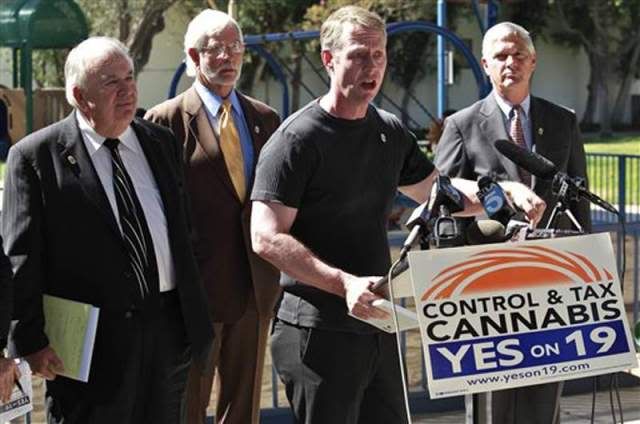

McNamara is joined by other members of LEAP (Law Enforcement Against Prohibition)
From left, Stephen Downing, retired deputy chief of the Los Angeles Police Department, William Fox, former deputy Los Angeles County District Attorney's Office, former Torrance Police Department beat officer and drug identification expert Kyle Kazan, at podium; and retired Orange County Superior Court Judge Jim Gray, right. (AP Photo/Damian Dovarganes)

Their statement was noted in the Press Democrat
Current law enforcement officials are obligated to support laws and are ethically unable to oppose it in public, but retired officers can speak out, said McNamara, who is now a research fellow at Stanford University’s Hoover Institute.

“We’re pushing police into a war they didn’t declare and they can’t win, and that comes at so much cost to taxpayers and society,” he said.

Nationally, President Barack Obama’s director of the Office of National Drug Control Policy, Gil Kerlikowske, spoke out against the proposed law. Nine former Drug Enforcement Administration bosses wrote in a letter to Attorney General Eric Holder that legalizing the drug threatens federal authority.

Federally authority should be threatened when it insists on bad laws.

An interview with Ethan Nadelmann, exec. director of the Drug Policy Alliance

Alternet

Nadelmann talks about the concept of harm reduction as a paradigm shift.
(From drug policy)...in which criminal justice approaches are dominant to one in which health approaches are dominant. So much of drug policy takes place on the ground, and so much involves both governmental and non-governmental agencies and workers -- cops, prosecutors, housing, public welfare, health, you name it. We’re just trying to come up with pragmatic solutions.

These events push in a new direction: To reduce our reliance on a criminal justice and punitive approach in dealing with drugs, and to elevate the role of health in dealing with people who are addicted; To focus criminal justice resources on the harms that people do to one another, rather than simply arresting people for drugs; To move toward decriminalization of drug possession, both for those who are addicted and want help and for those who don’t have a drug problem and should essentially be left alone.

Nadelmann goes on to mention that Prop. 19, the ballot initiative to legalize cannabis, has an amazing 70% recognition rate - that's a phenomenal number of people who know what this issue is and why it is on the ballot. He compares this moment with past initiatives that involved reforms in the criminal justice system (Prop. 5) - which was torpedoed by a political maneuver by Jerry Brown (with help, Nadelmann notes, from the quarter million that Meg Whitman devoted to its demise), and Prop. 25, a move to treatment rather than punishment in drug sentencing that passed with 61% of the vote a decade ago, in spite of opposition from politicians and law enforcement. At this moment, depending on polls, Prop. 19 polls at 50/50 (tho electronic polls show a majority of Californians favor the initiative.) Nevertheless, in spite of recognition, Prop. 19 is not a sure thing and voter turn out will be essential to its passage.

He notes that:
There’s no simple easy way to jump from where we are today to a world in which marijuana is legally regulated and taxed in the US and Mexico and much of the rest of the world. It’s going to be a messy political process, with inconsistencies in laws and enforcement and different forms of decriminalization and people exploiting that, but it’s ultimately the only solution that can really reduce the violence and murder and mayhem. We really have no choice but to head down this road, negotiating the twists and bumps along the way, until both the US and Mexico, and other countries as well, are ready to embrace a more rational and orderly system of marijuana regulation.

Nadelmann credits the Obama administration for its stance and actions on three policy changes: raids on medical marijuana facilities, needle exchange and differential sentencing for types of cocaine (crack v. powder.) He also talks about the political reality of any attempt to create change with the current Republican mindset and the nasty political atmosphere that seeks to label any move away from Calvinist punishment drug policy to health-centered harm reduction as a "soft on crime" stance. Current federal funding reflects this political reality.

Nevertheless, Nadelmann observes: Obama made another commitment when he was running for office – that he would no longer allow science to be trumped by politics. But in the drug area, they continue to let it happen.

From Terrence McNally (the interviewer):
On July 27 the House unanimously passed HR5143, which, if enacted, creates a bipartisan commission to conduct a top to bottom review of the entire criminal justice system, and offer concrete recommendations for reform within 18 months. This is the companion bill to Senator Jim Webb’s S714, already approved by the Senate Judiciary committee. According to Senator Webb, legalization should be on the table for discussion.

These are bills to watch for anyone who supports sane drug policy. One issue the House can bring up for consideration is the rescheduling of cannabis. This one change can have major implications. It's not the only change we need, but it's a major move that needs to be made to bring current drug law in line with current medical research.

UK's Leading Pharmacological Expert on Cannabis To Call for Legalization

Financial Times

Roger Pertwee, professor of neuropharmacology at Aberdeen University, will on Tuesday tell the British Science Festival in Birmingham that making cannabis available from licensed outlets would reduce drug-related crime and cut the risk of users moving on to more dangerous drugs.

“At the moment cannabis is in the hands of criminals,” he will say. “We are allowed to drink alcohol and smoke cigarettes. Cannabis, if it is handled properly, is not going to be more dangerous.”

Although research has shown cannabis may increase the risk of developing schizophrenia in particularly vulnerable individuals, this danger does not apply to the general population, he will say. The risk could be reduced by setting a minimum age of 21 for consuming cannabis or requiring individuals to obtain a licence to buy it.


The article is very short - but behind a free registration wall.

Pertwee was involved in the development of Sativex for MS patients - so he has a pretty good idea of the way in which cannabinoids function - and an understanding of the medical uses of cannabis extracts.

The First Post

Pertwee's recommendation to "license" cannabis users (does the UK "license" beer drinkers?)...

comes almost a year after the Labour Home Secretary Alan Johnson fired Professor David Nutt, the chairman of the Advisory Council on the Misuse of Drugs (ACMD) and the government's top drugs advisor, after he suggested that drugs such as cannabis and LSD were less harmful than alcohol.

Prior to that, the Labour government had upgraded cannabis from a Class C to a Class B drug against the advice of the ACMD. So it was no surprise when another seven members of the ACMD resigned after Nutt's dismissal - either citing Nutt's shoddy treatment or the government's prohibitionist attitude towards drugs.

Edited to add Pertwee on the BBC

Personally, I find the idea of an individual "license" to be ridiculous - just another indication of how irrational people are about the issue of cannabis. Liquor stores require licenses. They are required to abide by the law and not sell to minors. They are not required to screen all customers for signs of mental illness - because the idea is ludicrous - just as it is for cannabis.

Monday, August 9, 2010

A Unique Chance to Rethink Drug(s) Policy

Guardian UK

If the purpose of drug policy is to make toxic substances available to anyone who wants them in a flourishing market economy controlled by murderous criminal gangs, the current arrangements are working well.

If, however, the goal is to reduce the amount of drugs being consumed and limit the harm associated with addiction, it is surely time to tear up the current policy. It has failed.

Few nations are untouched by what is, after all, a multibillion pound global industry. Importing countries, such as Britain, must cope with the social effects of addiction and end up squandering the state's resources on a Sisyphean policing task.

But that suffering is mild compared to the destructive forces unleashed on exporting countries.


The article goes on to note that the current and former Presidents of Mexico have called for a debate on current drug policies. Other former Latin American heads of state have called for legalization to stop the flow of money to drug cartels and to decrease violence.

Why did violence subside after the end of prohibition? People who were making and delivering alcohol illegally were able to do so without bribes. They could avail themselves of the legal system to settle disputes, rather than the rough justice of criminality. Makers of alcoholic beverages from other nations were allowed to export their product to formerly closed markets. Those who chose to be criminals, rather than beverage producers, found other areas of criminality to exploit and law enforcement officials were able to focus on other criminal activities.


...The unthinkable is creeping into the realm of the plausible. In the US, several states have relaxed cannabis law, a trend driven by a loose coalition of hard right libertarians and soft left baby-boomers. American society is slowly coming to terms with the fact that drugs are part of its everyday reality and that control might be more effective if use was allowed within the law, not forced outside it.

Politicians have generally shown little courage in confronting inconvenient truths about drugs. And the longer a government is in office, the more it feels bound to defend the status quo; to do otherwise would be admitting complicity in an expensive failure.

Prohibition entails a double dishonesty. First, there is the pretence that the supply and demand can be managed by force. But anyone who has experienced addiction knows that banning a substance restricts neither access nor desire. Usually, it makes matters worse, bringing otherwise law-abiding people into contact with professional criminals. Most addicts, meanwhile, say their problems start with the need to annihilate feelings of despair or memories of trauma. Prosecuting them for those problems solves nothing.

Vancouver, B.C. Concerns on the Impact of Prop. 19 on the Canadian Economy

Cannabis News via The Victoria Times-Colonist

In a column on the Guardian’s website this week, B.C. writer Douglas Haddow writes that a move to legalization would be “devastating to the Canadian economy, halting the flow of billions of dollars from the U.S. into Canada.”

B.C. marijuana activist Marc Emery – the selfstyled “Prince of Pot” who is awaiting sentencing in the U.S. for distributing cannabis seeds – - recently told a Vancouver website that “the homegrown market will evaporate.”

Marijuana production generates at least $3 billion to $4 billion in B.C. alone – due, in large part, to heavy demand from potheads south of the border, said Darryl Plecas a criminology professor at the University of the Fraser Valley in Abbotsford.

Plecas said he estimates that about 70 per cent of all marijuana produced in B.C. is sent to the U.S. and much of it goes to California.


(I love the criminology professor's "judicious" use of language.)

Other observers, however, are more circumspect about how crippling legalization would be for Canadian producers, pointing out that “B.C. Bud” still enjoys a reputation in many circles as “the Rolls-Royce” of marijuana and that there are many other U.S. states – besides California – that covet Canadian-grown marijuana.


The article goes on to note various opinions about the the immediate impact (Mexican bud will fare worse, the illegal exchange of Canadian pot and cocaine will continue, the rise of the loon against the dollar hasn't hurt exports...)

Thursday, August 5, 2010

Texas and Medical Marijuana

Texas Tribune


(Stephen) Betzen is now the executive director of Texas Coalition for Compassionate Care, a Dallas-based nonprofit that, alongside Texas NORML and Medcan University, is lobbying legislators in hopes of reforming Texas’ marijuana laws. The organizations don't agree on strategy, however, with the TCCC pushing only for a limited law allowing medical use as a defense against criminal charges, and the others seeking broader legalization that would include permitting and regulating sales outlets.

...Though they are pursuing different strategies, Betzen, Picazo and Schimberg have similar goals and have been busily meeting with lawmakers for weeks. They won’t say which lawmakers, however, as some still view any connection to the legalization movement as a political liability. But they cite a poll that found a majority of Texans support legalizing marijuana for medicinal purposes. A University of Texas/Texas Tribune poll conducted in May showed a similar finding, with the majority of Texans favoring one or more methods of legalization: 42 percent of Texans were open to the idea of legalizing marijuana, 28 percent say possession of small amounts should be legal, and 14 percent said any amount should be legal. Twenty-seven percent said it should be legal for medical purposes only, and another 27 percent said it should be illegal under any circumstances.

Wednesday, August 4, 2010

How the Federal Government Could Reschedule Cannabis

Drug Schedules are part of the Controlled Substances Act, passed by Congress in 1970, that defines federal drug policy. There are five schedules, or classifications for drugs, to determine federal policy on those substances.

Schedule I.—

(A) The drug or other substance has a high potential for abuse.

(B) The drug or other substance has no currently accepted medical use in treatment in the United States.

(C) There is a lack of accepted safety for use of the drug or other substance under medical supervision."

No prescriptions may be written for Schedule I substances, and such substances are subject to production quotas by the DEA.


The DEA and the FDA determine the scheduling of various substances, although Congress scheduled a substance via legislation in Feb. 2000. The Attorney General of the United States may also initiate a drug rescheduling hearing.

Cornell University Law School Legal Information Institute

...Proceedings for the issuance, amendment, or repeal of such rules may be initiated by the Attorney General

(1) on his own motion,
(2) at the request of the Secretary, or
(3) on the petition of any interested party.

The Attorney General shall, before initiating proceedings under subsection (a) of this section to control a drug or other substance or to remove a drug or other substance entirely from the schedules, and after gathering the necessary data, request from the Secretary a scientific and medical evaluation, and his recommendations, as to whether such drug or other substance should be so controlled or removed as a controlled substance.

...if the Secretary recommends that a drug or other substance not be controlled [or be rescheduled], the Attorney General shall not control the drug or other substance. If the Attorney General determines that these facts and all other relevant data constitute substantial evidence of potential for abuse such as to warrant control or substantial evidence that the drug or other substance should be removed entirely from the schedules, he shall initiate proceedings for control or removal, as the case may be, under subsection (a) of this section.

Factors determinative of control or removal from schedules

In making any finding under subsection (a) of this section or under subsection (b) of section 812 of this title, the Attorney General shall consider the following factors with respect to each drug or other substance proposed to be controlled or removed from the schedules:

(1) Its actual or relative potential for abuse.
(2) Scientific evidence of its pharmacological effect, if known.
(3) The state of current scientific knowledge regarding the drug or other substance.
(4) Its history and current pattern of abuse.
(5) The scope, duration, and significance of abuse.
(6) What, if any, risk there is to the public health.
(7) Its psychic or physiological dependence liability.
(8) Whether the substance is an immediate precursor of a substance already controlled under this subchapter.


In 1992, DEA administrator Robert Bonner created 5 criteria for determining whether a substance has medicinal value.

The DEA claims that cannabis has no accepted medical use because it does not meet all of these criteria:

* The drug's chemistry is known and reproducible;
* There are adequate safety studies;
* There are adequate and well-controlled studies proving efficacy;
* The drug is accepted by qualified experts; and
* The scientific evidence is widely available.

(Information on Drug Schedules and Information on attempts to reschedule cannabis via Wiki)

On October 18, 1985, the DEA issued a Notice of Proposed Rulemaking to transfer "Synthetic Dronabinol in Sesame Oil and Encapsulated in Soft Gelatin Capsules" — a pill form of Δ9-tetrahydrocannabinol, the main psychoactive component of cannabis, sold under the brand name Marinol — from Schedule I to Schedule II (DEA 50 FR 42186-87). The government issued its final rule rescheduling the drug on July 13, 1986 (DEA 51 FR 17476-78). The disparate treatment of cannabis and the expensive, patentable Marinol prompted reformers to question the DEA's consistency.

In the summer of 1986, the DEA administrator initiated public hearings on cannabis rescheduling. The hearings lasted two years, involving many witnesses and thousands of pages of documentation. On September 6, 1988, DEA Chief Administrative Law Judge Francis L. Young ruled that cannabis did not meet the legal criteria of a Schedule I prohibited drug and should be reclassified. He declared that cannabis in its natural form is "one of the safest therapeutically active substances known to man. (T)he provisions of the (Controlled Substances) Act permit and require the transfer of marijuana from Schedule I to Schedule II".

Then-DEA Administrator John Lawn overruled Young's determination. Lawn said he decided against re-scheduling cannabis based on testimony and comments from numerous medical doctors who had conducted detailed research and were widely considered experts in their respective fields. Later Administrators agreed. "Those who insist that marijuana has medical uses would serve society better by promoting or sponsoring more legitimate research," former DEA Administrator Robert Bonner opined in 1992.


So, what has medical research into the use of cannabis revealed since 1992? Because of the Federal Scheduling, much of the legitimate research has gone on outside of the United States.

Recent medical research on cannabis, via NORML

...There are now more than 17,000 published papers in the scientific literature analyzing marijuana and its constituents...Whereas researchers in the 1970s, 80s, and 90s primarily assessed cannabis' ability to temporarily alleviate various disease symptoms — such as the nausea associated with cancer chemotherapy — scientists today are exploring the potential role of cannabinoids to modify disease.

Of particular interest, scientists are investigating cannabinoids' capacity to moderate autoimmune disorders such as multiple sclerosis, rheumatoid arthritis, and inflammatory bowel disease, as well as their role in the treatment of neurological disorders such as Alzheimer's disease and amyotrophic lateral sclerosis (a.k.a. Lou Gehrig's disease.)

Investigators are also studying the anti-cancer activities of cannabis, as a growing body of preclinical and clinical data concludes that cannabinoids can reduce the spread of specific cancer cells via apoptosis (programmed cell death) and by the inhibition of angiogenesis (the formation of new blood vessels). Arguably, these latter trends represent far broader and more significant applications for cannabinoid therapeutics than researchers could have imagined some thirty or even twenty years ago.


This article includes links to information about cannabinoid research for 19 different health issues, with links to the studies relating to the medical condition.

I'm sure the executive branch will not step in front of a bill before a state to appear to take a position on this issue. However, in order to facilitate an end to the war on drugs if California does legalize cannabis, the Attorney General (or any citizen's group) could call for a rescheduling hearing to bring cannabis scheduling in line with legitimate, peer-reviewed research that has occurred over the last 18 years.

(h/t to beowulf in comments at Just Say Now)

Monday, August 2, 2010

Democrats Want the Pro-Prop 19 Vote, but not the Legislation

Huffington Post (Russ Bellville)

Ryan Grim at Huffington Post reports on the notion going round political circles that California's Prop 19 (and, to a lesser extent, medical marijuana initiatives in Arizona and South Dakota, and dispensaries for medical marijuana in Oregon) will be for the Democrats what anti-Gay Marriage Equality amendments were for Republicans - the turn-out-the-base social wedge issue that helps their candidates on the ballot.

...Democrats are in for a surprise. See, Karl Rove and the Republicans really believed in the initiatives they were pushing. They had a frame for it - "one man one woman" - that resonated with their voters and the overall worldview espoused by most of their downticket candidates. So when that Religious Right base came out in 2004, energized to vote against dreaded homosexuals and for the continuation of all that was good, true, and Christian in America, they had George W. Bush and a whole slew of Republicans to vote for that echoed that sentiment.

What do Democrats have to offer the cannabis consumer who comes out for a 2010 election? Unlike Rove and the Republicans, the Democrats don't really believe in these initiatives (publicly). Sen. Boxer, Sen. Feinstein (a former mayor of San Francisco, c'mon now!), and former Gov. / current AG Jerry "Moonbeam" Brown all publicly oppose Prop 19...

...[In 2008, social liberals] "surged", in the real world and especially online, and got Obama elected. We even got him a massive majority in Congress. We were thrilled when he asked us online what items we'd like to see on the new administration's agenda and multiple times we responded with "legalize marijuana", topping almost every public survey and dominating with 16 of the top 50 questions in the largest survey. So what did we get in response? Something we in marijuana law reform simply call "The Chuckle"

...Republicans already have the frames of "small government", "personal responsibility", and "states rights" to work within. If marijuana legalization in California passes by a wide margin and sees support from the women, minorities, and young people the GOP desperately needs to rebuild their party, how long before they begin framing the War on Drugs as the "big government", "nanny state", and "federal overreach" that it is? ...They can easily point to the Democratic Congresses of the 1980s that created the mandatory minimums and the last three Democratic presidents who supported decriminalization and inhaled or didn't inhale yet arrests kept increasing (at the greatest rate under Clinton, they'll note).

...Just in time for 2012 when a vocally pro-marijuana legalization, anti-prohibition former governor of New Mexico named Gary Johnson will be fighting for the Republican nomination.

The Obama Administration has been incredibly tone deaf and outright offensive about the issues that brought out the base in 2010, from gay rights to cannabis-law modification to women's reproductive choice to overturning the abuses of power of the Bush administration in regard to FISA, for instance, while seemingly engaged in an effort to court the social/religious conservative Republican and Democratic Dixiecrat base that comprises a smaller number of voters than the liberal and libertarian free market one (based upon Pew polling from 2008 that divided voters into voting and economic sectors.)

This tact would appear to relate to the Democratic idea that social liberals have no other party to vote for and to Rahm Emmanuel's view of the liberal base as "fucking retards."

The Dixiecrats and their kissing cousins in states like Nebraska (Ben Nelson) threaten to alienate the Democratic base from the party - while offering little in return for this pandering if you look at Nelson's votes, for instance.

Democrats seem to be fighting the political wars of the 1980s and the 1990s while defining themselves in terms derived from the Republican attack machine, rather than creating a truly hopeful vision for an America in a new millennium.

Oakland's Post Drug War Marshall Plan

L.A. Times

This article is a profile of Jeff Wilcox, the person who has promised a a $20 million dollar investment in Oakland to create a large-scale growing operation.

Wilcox quote: In essence, you could say big business is here.

Comparing the economic potential of tetrahydrocannabinol to silicon chips may seem far-fetched. Some observers dismiss the notion as the fever dream of budget-traumatized politicians. But others think Oakland could be uniquely positioned to capitalize on the business opportunities created by the growing tolerance toward marijuana.

[City Council Member Rebecca] Kaplan said she believed that Oakland has two essential ingredients other California cities do not: political will and industrial space. "Oakland has been a major hub of the medical cannabis movement, so that's part of what I mean when I say political will," she said.

No other city has provided such red-carpet treatment. Oakland is essentially trying to set up legal sanctuaries for pot businesses, although the move may prove too brazen for federal narcotics agents who recently called city officials to request a copy of the [legal, large-scale cannabis growers] ordinance.

Oakland, like Silicon Valley, has been fertile ground for entrepreneurs and innovative thinkers, luring them from all over. Jones is from South Dakota. Richard Lee, who started the first trade school to train marijuana businessmen, moved from Texas. Steve DeAngelo, who came from Washington, D.C., runs Harborside Health Center, a $20-million-a-year dispensary that has become the largest and arguably the most professionally run marijuana retailer in the world.

Just as the repeal of prohibition became unavoidably attractive during the great depression, the approval and regulation of cannabis growing offers a way to create jobs within a legal framework (at the state and city level) for workers who have been decimated by two decades of the globalization of capitalism and its attendant frenzy for shareholder profits at the expense of America's working middle class.

Sunday, August 1, 2010

Will California Legalize Pot?

An excellent article from Alternet

The reality of the matter is that Prop. 19 has the deck stacked against it simply because there is no precedent for a voting public of a state to endorse removing all civil and criminal penalties associated with adult marijuana use. All preceding efforts have met sad ends: A 1972 measure also called Prop. 19 failed in California; more recently, attempts in Alaska, Colorado and Nevada were also rejected. In the face of decades of federal and state prohibition, it is still much easier to vote no than yes, even in the face of convincing arguments to do otherwise.

...Polls in April and May found support at 56 percent and 51 percent, respectively. A SurveyUSA poll released this month shows support at 50 percent, 10 points over those against it. A new Public Policy Polling poll found the divide to be even greater, with 52 percent supporting and 36 percent nixing it -- and the campaign says these results are more consistent with its internal polling. But another poll also released this month, the Field poll, showed that more people oppose the initiative than support it, at 48 to 44 percent. (This contrasts with the last Field poll, conducted over a year ago, which found support at 56 percent.) No matter which numbers you're looking at though, 50, 52 or even 56 percent isn't all that comforting. It's one thing to say yes to a pollster, it's quite another thing to get out and vote that way.

"Progressive drug reform on the California ballot needs to be polling in the high 50s or low 60s," says Stephen Gutwillig, the California director at the Drug Policy Alliance. "This is because they generally have nowhere to go but down because of the fear-mongering that usually occurs at the hands of the law enforcement lobby which tends to not need as much money to push their regressive fear-based messages."

Mauricio Garzon, the even-tempered campaign coordinator, admits polls could be better but is sure that something even more important is happening. "We're seeing a legitimization of this issue, politically. There was a time when this was impossible," he says. "You reflect on this and you see a shift in public sentiment and this is what this campaign has always been about. Making Americans understand how important this issue is. It's a real issue and the existing framework has been devastating to our society."

Indeed.

Thursday, July 29, 2010

43% in Rasmussen Poll Favor Legalization

Rasmussen Reports

Americans are evenly divided over whether marijuana should be legalized in the United States, but most expect it to happen within the next decade.

The latest Rasmussen Reports national telephone survey of Adults nationally shows 43% believe marijuana should be legalized. But 42% think it should remain an illegal drug. Another 15% are not sure.

These results show a slight shift toward legalization from February of last year.

However, 65% believe it is at least somewhat likely marijuana will be legalized in the United States in the next 10 years. Just 28% do not expect this to happen. Those numbers include 29% who say it is Very Likely pot will be legal in the next 10 years and five percent (5%) who say it is Not At All Likely.

In the latest survey, voters were simply asked whether or not they believed marijuana should be legalized. Voters were more divided on this question than they were in May of last year, when asked whether the drug should be legalized and taxed. At that time, 41% favored the idea of legalizing and taxing marijuana, while 49% were opposed.

That's legalization, not decriminalization or merely support for medicinal marijuana. Support for medicinal marijuana tracks at over 70%